The Book
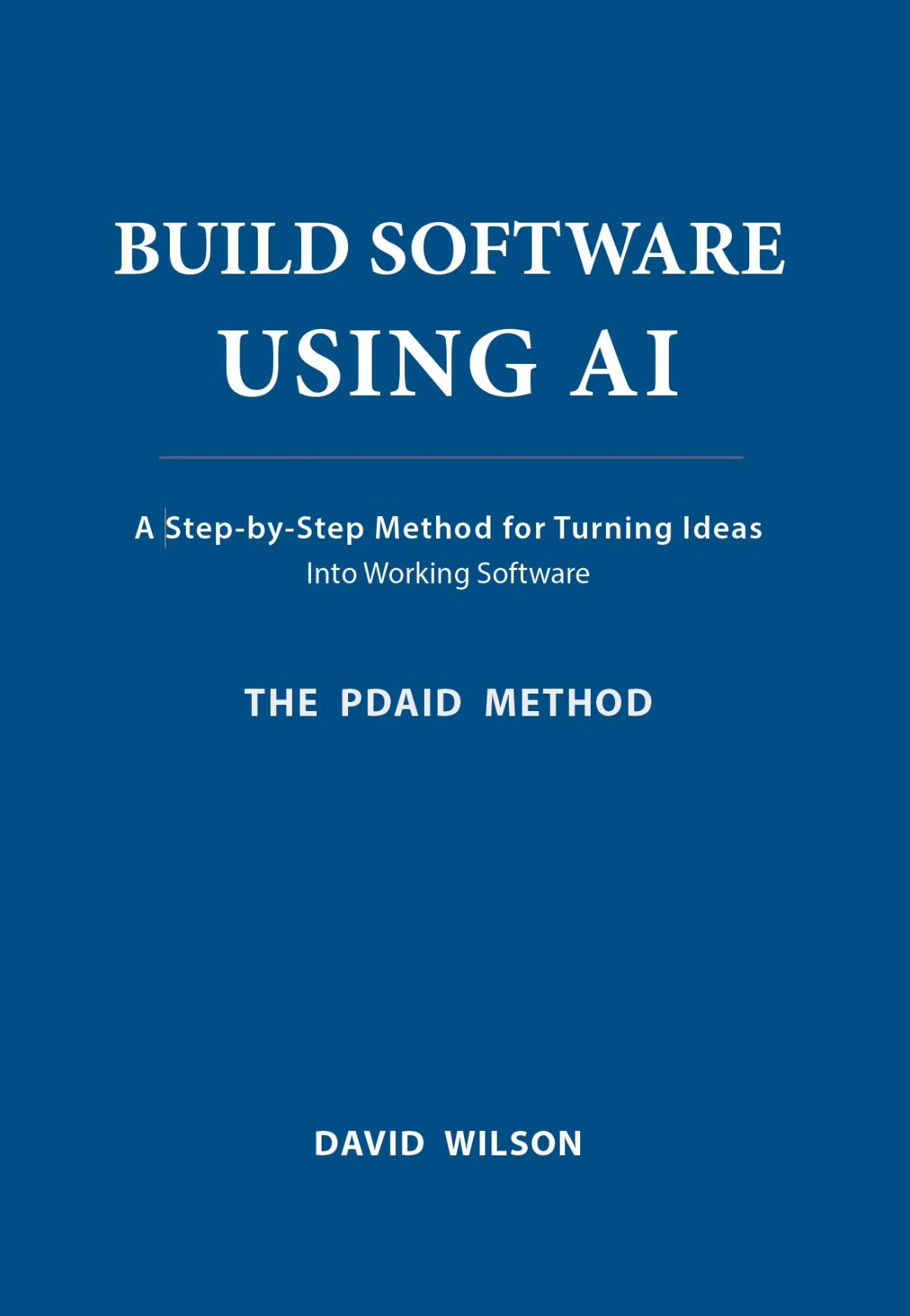
Build Software Using AI
A Step-by-Step Method for Turning Ideas Into Working Software
AI has made software implementation more accessible, but producing code is only part of building reliable software. The difficult work increasingly lies in deciding what should be built, describing how it should behave, controlling scope and verifying the result.
Build Software Using AI introduces PDAID — Prompt-Driven AI Development — a practical, behaviour-first method for turning ideas into working software through small, controlled and testable increments.
What you'll learn
A method for directing AI without losing control.
The book focuses on the decisions that make AI-assisted development dependable, from defining the work clearly to testing and preserving each accepted result.
Define purpose before building
Establish the useful outcome before implementation begins.
Describe behaviour clearly
State what the software should do in observable, testable terms.
Remove ambiguity before AI guesses
Resolve missing decisions, assumptions and edge cases before they become implementation choices.
Build in small, controlled increments
Keep each change understandable, testable and recoverable.
Test and correct with confidence
Compare the result with accepted behaviour and correct the smallest understood difference.
Maintain control as the project grows
Preserve stable baselines so future work begins from something understood and dependable.
Inside the book
From first principles to a complete working cycle.
The book develops PDAID in stages. It begins with the change AI has brought to software development, builds the seven-phase method step by step, then applies it repeatedly to a working software project.
- 01 Foundations Understand what has changed, what you need to direct AI effectively and why behaviour, scope and human judgement matter.
- 02 The seven PDAID phases Work through Purpose, Behaviour, Clarifications, Context & Constraints, Build, Test & Correct, and Commit & Maintain in sequence.
- 03 Control and judgement Learn how to contain scope, recognise project drift, respond to failure and decide when evidence is strong enough to continue.
- 04 A complete worked application Follow the method through successive increments as a simple list application gains display, add, edit, delete and persistence behaviour.
Worked example
One project. Repeated PDAID cycles.
The final chapters follow a deliberately small list application from its first visible behaviour to a completed, persistent system. Instead of asking AI to build everything at once, the project grows through separate, verified increments.
- Broad idea
- Build a simple list application where users can view, add, edit and delete items, with their changes still available when they return.
- First increment
- Display a short list of items when the application opens.
- Display a short list
- Add items
- Edit items
- Delete items
- Preserve changes
- Test the complete system
Practical material
Templates and checklists you can reuse.
The appendices turn the method into practical working material that can be reused while planning, building, testing and maintaining your own projects.
Appendix A
The Seven-Phase Checklist
A working checklist covering the complete PDAID cycle.
Appendix B
PDAID Planning and Build Template
A structured template for carrying accepted decisions from Purpose through to the Build prompt.
Appendix C
Testing, Correction and Maintenance
Reusable records and prompts for verifying behaviour, diagnosing defects, making bounded corrections and preserving a stable result.
The three appendices above are printed in the book. Separately, this site publishes practical articles on the same problems and reusable templates and records, both free to use without it.
Get the book
Two ways to read it.
The direct edition and the Kindle edition are the same book in different formats. Buying direct gives you EPUB and PDF files you keep; the Kindle edition is read in Kindle apps and devices.